Officers overlook six pipe-bombs, guns, detonators, ammunition in Somali suspected terror plotter’s Toyota four-wheel-drive
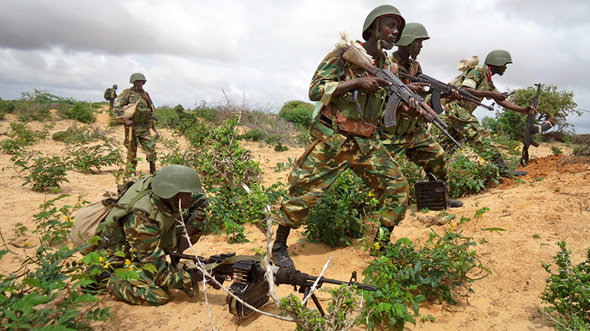 |
| Kenyan Defence Forces inside Somalia in 'Operation Linda Nchi' |
Kenyan police failed to realize that a car that they impounded from a Somali
man and stored outside their anti-terror unit offices for a week was packed
full of explosives already attached to a Nokia detonator.
The blue Toyota four-wheel-drive was only thoroughly checked when foreign
counter-terror officers believed to be from the FBI saw the vehicle and recognized it was on an international alert list.
Six separate pipe bombs made up of a total of 130lb of plastic explosive were
welded into the vehicle’s rear seats, enough to collapse a multi-storey
building, according to Kenyan police.
An AK-47, 250 rounds of ammunition, detonators and grenades were also found
when a full search was eventually carried out and completed on Tuesday.
The vehicle was impounded in the Kenyan port city of Mombasa on March 11, and
the driver, a Somali, and his passenger, a Kenyan of Somali origin, were
arrested and charged with illegally importing a vehicle.
Fresh charges linked to international terrorism will now be drawn up,
prosecutors in Mombasa said.
Security sources in the city said initial investigations suggested one of the men had called telephone numbers also contacted by suspected terrorists linked to Kenya’s Westgate attack in September, but this could not be confirmed.
“This is a continuous investigation process and it is not correct to give details before everything is known,” Robert Kitur, Mombasa police chief told the media.
The amount of explosives were enough to cause “mass destruction”, but the potential target was not yet known, another senior official, Nelson Marwa, Mombasa county commissioner, said.
The vehicle was a collection of parts from different cars, he added.
"It is a Toyota ... the chassis does not belong to that vehicle, the engine does not belong to that vehicle, the number plate does not belong to that vehicle," Mr Marwa said.
Islamic extremists in Somalia have vowed to continue attacks on Kenya, following the Westgate siege in September, when 67 civilians died after four gunmen took over the upscale mall in the capital, Nairobi.
They were sent by al-Shabaab, Somalia’s al-Qaeda-linked militia, which on Monday carried out a suicide bombing of a hotel in southern Somalia where African Union soldiers had gathered. Eight were killed.
Separately, Uganda’s intelligence services have warned that al-Shabaab cells may be planning to hijack petrol transport lorries and use them as improvised truck bombs.
Security sources in the city said initial investigations suggested one of the men had called telephone numbers also contacted by suspected terrorists linked to Kenya’s Westgate attack in September, but this could not be confirmed.
“This is a continuous investigation process and it is not correct to give details before everything is known,” Robert Kitur, Mombasa police chief told the media.
The amount of explosives were enough to cause “mass destruction”, but the potential target was not yet known, another senior official, Nelson Marwa, Mombasa county commissioner, said.
The vehicle was a collection of parts from different cars, he added.
"It is a Toyota ... the chassis does not belong to that vehicle, the engine does not belong to that vehicle, the number plate does not belong to that vehicle," Mr Marwa said.
Islamic extremists in Somalia have vowed to continue attacks on Kenya, following the Westgate siege in September, when 67 civilians died after four gunmen took over the upscale mall in the capital, Nairobi.
They were sent by al-Shabaab, Somalia’s al-Qaeda-linked militia, which on Monday carried out a suicide bombing of a hotel in southern Somalia where African Union soldiers had gathered. Eight were killed.
Separately, Uganda’s intelligence services have warned that al-Shabaab cells may be planning to hijack petrol transport lorries and use them as improvised truck bombs.